
Combat in numbers
Target locking
The amount of time that the targeting computer needs to process a selected landmark. The enemy can lenghten this time by using sensor suppressors, or totally confuse the computer with ECMs, forcing the attacker to restart the locking procedure.
Cycle time
The amount of time between two firing cycles, shortened by extensions and tunings.
Damage model
Each type of weapon can shoot four different kinds of ammunition, and each of them are a combination of the four different damage types, kinetic, seismic, thermal, and chemical damage. Targeted enemy armors provide some defense against these damages, each to a different extent.
Turrets: Target size / Hit dispersion
The quotient of the two parameters show the chance of a hit. For example if the target size of your enemy is 5, and your weapon's dispersion is 7, the chance of hit in one cycle is (5/7=0,71) 71%. In case the enemy's target size is 4, and your weapon's dispersion is 4, the chance of hit is (4/4=1) 100%.
Missiles: Target size / Explosion size
A major advantage of ballistic warfare is that missiles almost always hit - there is only a default 10% chance of missing. Unlike turrets, where the denominator element of the quotient is given by the weapon, the explosion size is a property of the ammunition (the missile). The quotient of the target and explosion size shows how much of the missile's damage affects the target. For example the target size of your enemy is 5, your missile's explosion size is 7, the missile unleashes only (5/7=0,71) 71% of its total damage. If the enemy's target size is 4, and your missile's explosion size is 4, the missile has a full effect (4/4=1) 100% on the target.
Optimal range
The most important parameter of a weapon is the distance it can fire with full effectiveness. While you shoot your target inside this range, the damage rate is maximum. Once the target gets out of it, you have to take falloff into account.
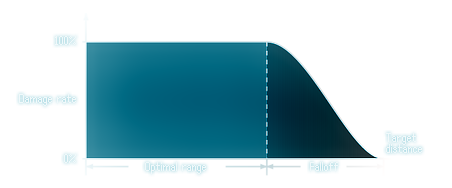
Falloff
If a the target gets out of your optimal range, the rate of damage decreases in proportion to range, until the target moves out of the falloff range too. The weapon then stops shooting - there is no hope of hitting the target.
Robot's sensor strength vs. EW strength
Each robot in Perpetuum has a unique value of sensor strength, that provides defense against enemy electronic warfare modules. Such electronic warfare modules, like the sensor suppressor (reduces targeting range and increases locking time) and the ECM (knocks out targeting computer) have an EW strength value that can be compared to the robot's original sensor strength. For instance your robot has a sensor strength of 100 Hw3, the suppressor (or ECM) has an EW strength of 50 Hw3, the chance of suppressing (or knocking out completely) your sensors is 50% in each firing cycle.
To defend yourself against electronic warfare, apply ECCM modules that increase the default sensor strength of your robot.
Energy neutralizers and drainers: Accumulator stability / Electrostatic dispersion
The efficiency of these two engineering modules also depend on the size of the target. To proceed with the above-mentioned example: your target's stability is 5, and your module's electrostatic dispersion is 7. The amount of energy drain changes accordingly, the module's default amount of 100 AP will decrease to 71 AP. (It might be worth noting that this doesn't work the other way around - efficiency will not go above 100% if your target's size is bigger than the module dispersion.)
Demobilizers and demobilizer resistance
Demobilizers are high-end tools of electronic warfare. You can slow down your targeted robot by activating the module on it by a significant rate. You can however defend yourself against this electronic web, by applying armor plates. If an enemy uses a demobilizer on you that reduces your top speed by 40%, and you had previously fitted an extra armor plate onto your robot that has a demobilizer resistance of 20%, the total speed reduction will be 20% (40%-20%).
Armor plates reduce the effect of demobilizers, but lightweight frames have the opposite effect, they will amplify the enemy demobilizer! E.g. a lightweight frame of -20% resistance will raise the total demobilizer effect on you to 60% (40+20)!
Critical hit
The default damage rate of your weapon is what the information panel tells you. There is an extension called critical hit, however, for you to raise the chance to reach an increased damage, a 1.75 multiplier of your weaponry's default damage.
Explosion damage
In case a robot is defeated in a battle and blows up, this explosion has an effect on the surroundings. Both the destroyed robot's total HP and the actual status of the accumulator affects the power of the inflicted collateral damage. This damage is at full measure inside a 20 meter range, then gradually degrades. It is important that explosion damage is active only in beta zones.
Copyright © Avatar Creations 2024


